
Mustelids tend to be portrayed as either a problem or a product, leading many of us to underestimate them in ways that have little to do with their perceived “viciousness” or “cuteness.” While we may recognise animals such as dogs, horses, and homing pigeons for their societal contributions, mustelids have also historically played an important role for both humanity and their respective species. This page honours past and present mustelids that merit remembrance for their contributions. Please be aware that our goal is not to list all mustelids within this category, but rather to highlight a select few with reputable sourcing.
Felicia
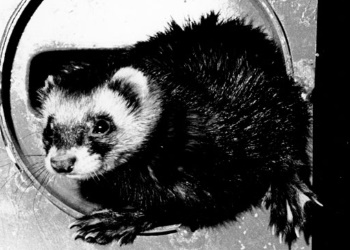
While they are most commonly viewed as pets, ferrets have often worked alongside and aided man-kind throughout history.
In 1971, one of the early challenges Fermilab faced with the construction of its particle accelerator was removing stray, steel shavings from the miles of stainless steel tubing that made up the main ring of the particle accelerator. Their solution came in the form of a small female ferret named Felicia.
Felicia was outfitted with a special collar that allowed her to pull a string through sections of the pipe without introducing any further obstructions. Femilab workers then attached a cleaning swap to the other end of the string and pulled it through the section of pipe to clean it. The possible issue of droppings was prevented by providing her with a diaper.(1)(2)
While Felicia was able to assist with clearing some segments of the tube, others were too lengthy for her—as she was unable to travel more than roughly 91 meters (300 feet). In late 1971, engineer Hans Kautzky designed a robotic spear that could draw a magnetic cable through the longer pipes. The laboratory soon after retired Felicia (she was intended to be a temporary solution), and she spent the rest of her life in the homes of the staff members who looked after her.(3) Felicia died on the 9th of May, 1972. A post-mortem examination revealed a ruptured abscess in her intestinal tract.(4)
Felicia was renowned during her time. She was discussed on radio, appeared on television, and had been featured in numerous newspapers and magazines with both national and international coverage.(3) Although largely forgotten today, she remains a special part of Fermilab’s history.
Similar stories
Note: It is unclear how many of those below are ferrets or European polecat-ferret hybrids.
During the lead-up to the Year 2000 (Y2K) transition, Air Force contractors struggled to run communication cables beneath the subfloors of the Center for Y2K Strategic Stability. USAF Lieutenant-Colonel Randy Blaisdell brought his pet ferret, Misty, from home and fitted her with a special harness. Misty successfully threaded cables through the narrow, 40-foot-long subfloor conduits, saving significant time and labour.(5)
In 1948, Freddie the ferret served as an electrician’s assistant in Auckland, New Zealand. He became a cultural icon after being officially registered as a member of the New Zealand Electrical Workers Union to thread cables through tight underground pipes.(6)
Beckham, Posh Spice, and Baby Spice were three ferrets that were recruited to save London’s Millennium Eve concert on December 31, 1999. Because crews could not dig up the protected turf at Greenwich Park, the ferrets were used to pull essential TV, audio, and electrical cables through the narrow underground tunnels.(7)
References Ferrets might be ideal candidates running cables but they are also renowned for flushing out game. In World War I, soldiers informally used ferrets for pest management and to flush out rabbits amid food shortages. Accounts from the trenches—such as those by Medical Officer Captain Arthur Hardwick—detail soldiers bringing ferrets into the medical posts to catch rabbits.(1)(2) The British Army’s 1st Battalion, The Yorkshire Regiment (now the Royal Yorkshire Regiment), would adopted ferrets as mascots during the First World War. This regimental tradition lasted for decades, with the ferrets historically named after battle honours like Imphal (refers to the 1944 Battle of Imphal during World War II) and Quebec (refers to the 1759 Battle of Quebec). The last Imphal and Quebec were gifted to the Battalion from a local farmer while stationed in Munster, Germany. They took part in parade marches for the regiment from around 2010 until 2012, even travelling with passports and their own miniature military jackets.(3)(4)(5) References
Ferrets Assisting in the Military