
(Enhydra lutris)


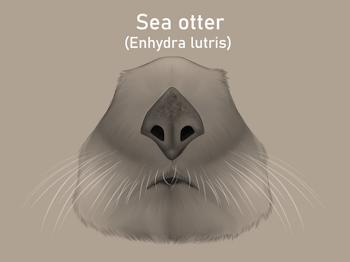
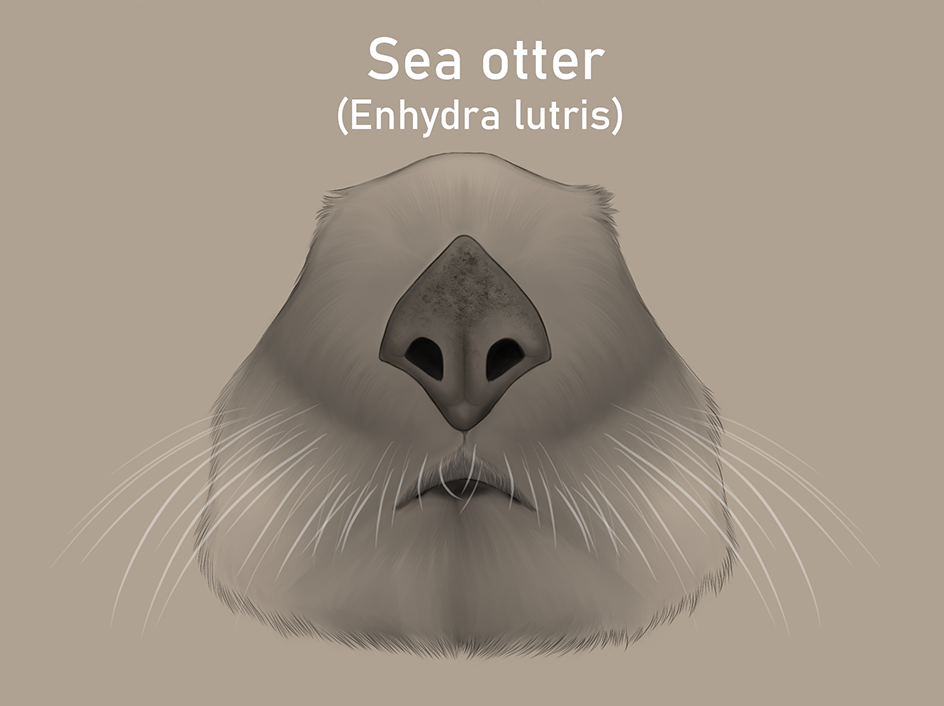
The sea otter is found along the coastal waters of east Russia, Alaska, British Columbia, Washington, and California. They are the heaviest and considered the most evolutionarily divergent species of all Mustelidae, being the sole otter species capable of living, sleeping, and giving birth entirely at sea without ever needing to come ashore.(1)
The common name “sea otter” can be misleading, given that not every otter spotted in the sea is necessarily a sea otter. This confusion has led numerous people visiting coastal regions to misidentify the Eurasian otter as Enhydra lutris.
Appearance
Sea otters are heavy set animals with short skulls and tails compared to other otters. Their bodies are dark, and they have light coloured heads. Their back legs have evolved into flippers and are not terribly useful for walking on land.
Habitat
Sea otters live off the northern Pacific coasts, ranging from Hokkaido through eastern islands of Russia to the west coast of North America. Being fully adapted to a marine lifestyle, they can spend their whole lives in the ocean and only go ashore whenever they choose.(1)
Behaviour
While most marine mammals keep themselves warm with a layer of blubber, sea otters instead have thick fur, which is the densest fur of the entire animal kingdom. They frequently groom their fur and blow air into it in order to maintain its insulating properties.(1)
A unique characteristic of the sea otter is their ability to use tools. They can use stones to smash shellfish. An anvil stone is laid on the stomach and the shellfish is held in the paws and smashed against the stone until it cracks. Stones can be stored in special pouches in the arm pits. Most sea otters have a favourite stone that they keep until it is worn out or broken. Abalones that are attached to rock walls may also be removed by smashing them with a sharp stone.
Another important part of their toolbox is kelp, which they use as an anchor. They wrap themselves and their pups in kelp in order not to drift off. They can even store live prey by wrapping it in kelp.
Reproduction
Due to delayed implantation gestation may vary in length but it’s usually around 5 to 7 months. In California, mating typically occurs from July to October and pups are born mostly from January to March. In Alaska on the other hand, mating occurs in September and October and births take place in May and June.(1)(2)
Males can be quite rough during mating—often biting the nose of the female, which can leave scars.(2)
Addressing reports of forced copulation with harbour seals
Male southern sea otters (Enhydra lutris nereis) without a territory tend to live in male groups and may have trouble finding a female to mate with. Males have been observed in Monterey Bay, California to forcefully copulate with juvenile (not necessarily baby) Pacific harbor seals (Phoca vitulina richardsi). These encounters are usually fatal for the seal. Similar behaviour has also been observed in other marine mammals.
One explanation for why this occurs with the southern sea otter is that males typically create a dominance hierarchy based on age, size, and relative fitness. Subdominant males will have less access to receptive females, and those seeking a female could result in interspecific sexual encounters. This aggressive copulatory behaviour is perhaps the outcome of a recent demographic shift in the population, which has resulted in a more male-biased sex ratio inside Monterey Bay, resulting in misdirected sexual activity in the lack of accessible female conspecifics.(3)
Unfortunately, rather than focus more on providing sensible reasons for why male southern sea otters may behave as they do, there are articles attempting to demonise them.(4)(5) These articles criticise the “moral compass” of male sea otters while simultaneously demonising the species as a whole. This anthropomorphising of sea otter behaviour has made its way to social media, where people are not always specific about (or simply do not know) what species of otter is being referred to. Needless to say, this has led many to falsely assume these minority behaviours are traits of all otter species.
Some articles begin with statements such as, “I thought otters were cute and cuddly” or, “Otters are not cute, they are sick depraved jerks” and so on. Therein lies the problem—we sometimes romanticise and infantilise wildlife to a point where we have idyllic and, frankly, childlike expectations. They are being unfairly chastised for failing to meet the standards we have ascribed onto them. It bears mentioning that the reproductive habits of seals are not always “chivalrous” either, as there have been reports of some seal species engaging in fatal forced copulation with seals of a different species and even penguins.(6)(7)(8) Given the latter fact, one may assume those who generalise otters as “rapists”, “murderers”, or “jerks” probably in reality care about seals as much as they do otters.
We must remember that wildlife is neither concerned with nor reasonably capable of living up to the moral standards of humans. That is, if we are genuinely interested in learning the reasons why they may behave as they do. A more in-depth read regarding this subject for the sea otter.
Diet
Sea otters eat various marine invertebrates, but also fish and may even occasionally catch a bird. They are especially good at controlling sea urchin populations, which has earned them the title “keystone species”. Areas where sea otters were hunted to extinction experienced a dramatic rise in sea urchin populations which in turn meant a dramatic decrease in kelp. On the other hand, areas where sea otters thrive have intact kelp forests, which provide shelter for various fish species.
Crabs, which eat animals like sea hares, are consumed by sea otters. Algae that grows on seagrass is eaten by sea hares. Seagrasses are suffocated and killed by excessive algae. By encouraging more algae-eating sea hares the sea otter’s crucial function in controlling crab populations in the seagrass environment benefits the health of the overall ecosystem.(9)
Predators
Their primary predator is the great white shark in California. Orcas are also reported to consume sea otters in Alaska, possibly due to the decline of seals and sea lions in that region. Natural disturbances to the ecosystem and overfishing may be another cause. On land, sea otters may also fall prey to stellar sea lions, coyotes, bears, and eagles.(10)
Threats
During the 18th and 19th centuries sea otters were almost hunted to extinction for their luxurious fur. Their original population of about 150 to 300 thousand had been reduced to less than 1 percent of its original size by the time the first hunting ban was introduced in 1911.(1)(2)
Modern threats include pollution from butyltin, organochlorine pesticides and PCBs, but also parasites from flushed cat litter.(1)
Conflicts with fisheries
After sea otters rebounded, southern Californian shellfish fishermen were concerned for their competition, so otter-free zones were implemented and sea otters were moved out to a nature reserve on San Nicholas Island. Unfortunately for the fisheries, the otters swam back and it turns out otter-free zones don’t work.(1)
Overfishing has also led sharks and orcas to hunt sea otters due to insufficient amounts of other prey.(1)

Body length: 119–149 cm / 3.9–4.9 ft (males), 101–140 cm / 3.3–4.6 ft (females)
Weight: 23–45 kg / 51–99 lb (males), 14–27 kg / 30–60 lb (females)
Lifespan: Up to 23 years (wild), up to 27 years (captivity)
Range: Coastal waters of east Russia, Alaska, British Columbia, Washington, and California. Some reports of recolonization in Mexico and Japan.
Conservation status: Endangered
Subfamily: Lutrinae
Recognised subspecies(11)
- Northern sea otter – (E. l. kenyoni)
- Southern sea otter – (E. l. nereis)
- Western sea otter – (E. l. lutris)
- Yoxon, Paul, and Grace M. Yoxon. “Otters of the world”. Whittles Publishing, 2014.
- Love, John A. “Sea otters”. Fulcrum Pub, 1992.
- Harris, Heather S., et al. “Lesions and Behavior Associated with Forced Copulation of Juvenile Pacific Harbor Seals (Phoca vitulina richardsi) by Southern Sea Otters (Enhydra lutris nereis)“. Aquatic Mammals 36.4 (2010).
- Matthews, Dylan. 20 December, 2019. “The case against otters: necrophiliac, serial-killing fur monsters of the sea“. Vox. Accessed 16 August, 2023.
- Hale, Tom. 30 May, 2018. “Otters Are Not Cute, They Are Sick Depraved Jerks“. Accessed 16 August, 2023.
- Rohner, Simon, et al. 13 August, 2020. “Male grey seal commits fatal sexual interaction with adult female harbour seals in the German Wadden Sea“. Scientific reports 10.1 (2020): 13679.
- Haddad, William A., et al. “Multiple occurrences of king penguin (Aptenodytes patagonicus) sexual harassment by Antarctic fur seals (Arctocephalus gazella)“. Polar Biology 38 (2015): 741-746.
- Schupak, Amanda. 25 November, 2014. “Strange but true: Seals found sexually assaulting penguins“. CBS News. Accessed 16 September, 2023.
- Schrodt, Leah. 22 September, 2022. “Sea Otters Are Unlikely Helpers in Our Fight Against Climate Change“. U.S. Fish & Wildlife Service. Accessed 24 August, 2023.
- Nickerson, P. “Sea Otter Frequently Asked Questions“. Defenders of Wildlife. p. 65. Archived from the original on 6 June 2011. Retrieved 20 July 2023.
- Wilson, Don E. & Reeder, DeeAnn M. (Editors) 2005. Enhydra lutris in Mammal Species of the World. – A Taxonomic and Geographic Reference.
Old World Otters | New World Otters | Sea Otter
Badgers | Ferret-Badgers | Fisher | Grisons | Martens | Otters | Tayra | Weasels | Wolverine